 Ancient Buddhist Heritage
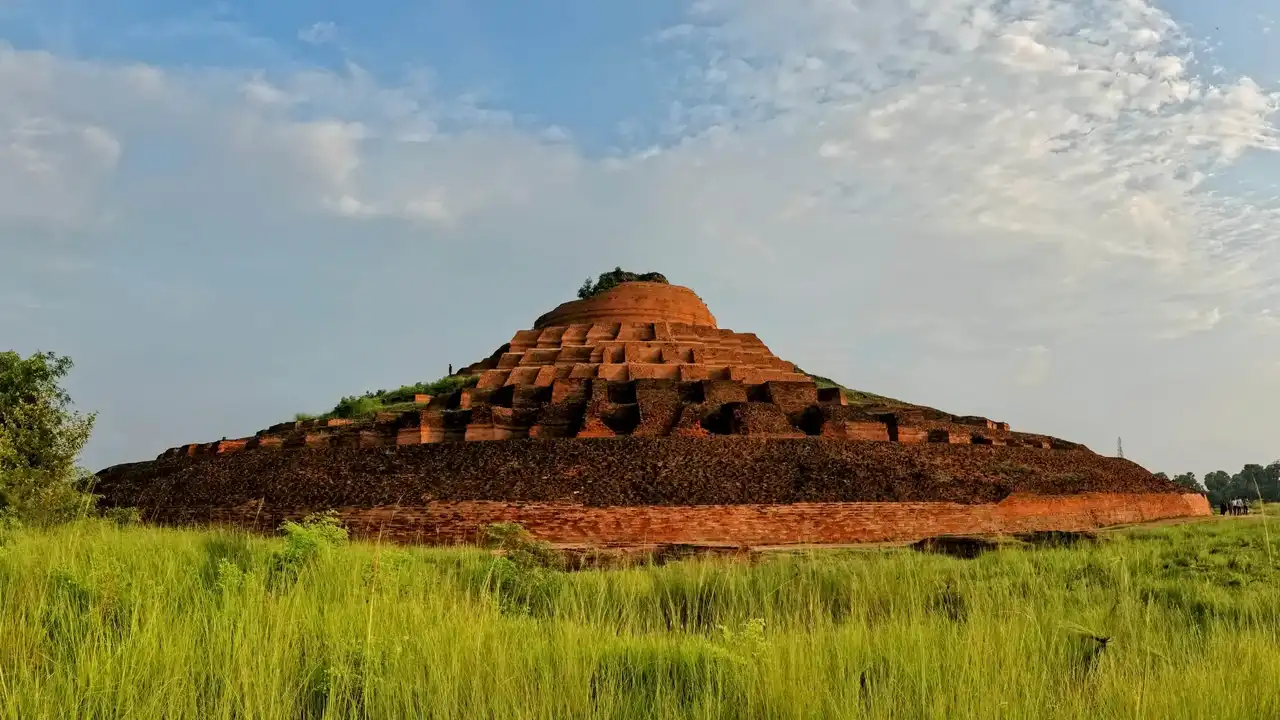
Kesariya Buddha Stupa
Discover the magnificent 3rd century BCE Buddhist monument commissioned by Emperor Ashoka in Bihar, India. Standing at 32 meters tall, it's one of the most significant archaeological treasures of ancient India.

3rd Century BCE

Emperor Ashoka

32 meters (104 ft)

~400 feet


A Monument of Mauryan Majesty
The Kesaria Stupa stands as a testament to Emperor Ashoka's devotion to Buddhism and represents one of the most remarkable architectural achievements of the Mauryan period.
The Ashokan Legacy
Built in the 3rd century BCE during the reign of Emperor Ashoka (268–232 BCE), the Kesaria Stupa was commissioned as part of Ashoka's grand Buddhist architectural program following his conversion after the Kalinga War (261 BCE). A capital of an Ashokan pillar was discovered on site, confirming direct Mauryan-era patronage.
The monument was not built once — it grew across four successive dynasties: a Mauryan brick nucleus (~250 BCE), expanded in the Gupta period (5th–6th century CE), with the uppermost standing structure dating to the Pala period (8th–12th century CE). Gold coins of Kushan emperor Kanishka were also found here, indicating patronage across centuries.
Originally standing at approximately 37 metres (123 feet), the stupa lost nearly 5 metres of height in the catastrophic 1934 Bihar earthquake (magnitude 8.1) — one of the deadliest earthquakes in Indian history. Even at its current height of 32 metres (104 feet) it towers nearly twice the height of Sanchi's Great Stupa.

Comprehensive Historical Timeline

Foundation Era
Emperor Ashoka's Reign
Ashoka's reign begins with military conquests
Kalinga War
Massive casualties lead to Ashoka's conversion
Embrace of Buddhism
Ashoka begins his dhamma campaign
Stupa Construction
Construction of Kesaria Stupa commissioned
Did you know? This was part of Ashoka's grand project of building 84,000 stupas across his empire to enshrine Buddha's relics.

Construction & Purpose
Pre-earthquake Height
~37 metres (123 ft)
Reduced to 32 m after 1934 earthquake
Construction Span
~1,500 years
Mauryan → Gupta → Pala phases
Religious Significance: Repository for Buddha's relics and meditation center
Location: Ancient trade route connecting Patna to Nepal

Medieval Period
7th-12th Century CE
- Chinese pilgrim Hiuen Tsang visits (636 CE)
- Describes flourishing monastery complex
- Gradual decline due to Muslim invasions
- Local worship continues among villagers

Colonial Discovery
19th Century
- 1814: Colin Mackenzie's first survey
- 1861-62: Alexander Cunningham's detailed study
- Recognition as ancient Buddhist site
- Initial conservation efforts begin

Modern Era
20th-21st Century
- 1934: Bihar earthquake (M 8.1) reduces height from ~37 m to ~32 m
- 1998: Major ASI excavation project
- 2024-25: New terrace, crescent path & stucco Buddhas discovered
- UNESCO World Heritage nomination strengthened
🏺Sacred Relics & Buddhist Significance
Understanding the profound spiritual significance and relic chamber traditions of the Kesaria Stupa
Historical accounts suggest that the Licchavis of Vaishali built the original structure to enshrine the sacred alms bowl (patra) given to them by Lord Buddha during his visits to the region.
Historical Context:
The Licchavi republic was one of the most progressive political entities during Buddha's time, and their devotion led to the construction of this monumental stupa as a repository for sacred relics.
Following traditional Buddhist architecture, Kesaria Stupa features a central relic chamber (garbha griha) within the hemispherical dome, designed to house sacred relics and offerings.
Architectural Elements:
- • Central sealed chamber within the anda (dome)
- • Stone casket system for relic preservation
- • Symbolic cosmic axis (axis mundi) representation
Kesaria Stupa holds immense importance in Buddhist pilgrimage traditions, representing one of the key sites associated with Buddha's physical presence and teaching in the region.
Pilgrimage Practices:
- • Circumambulation (pradakshina) rituals
- • Meditation retreats at terraced levels
- • Prayer wheel installations on pathways
As part of Bihar's Buddhist Circuit, Kesaria Stupa connects pilgrims to other significant sites including Bodh Gaya, Nalanda, Rajgir, and Vaishali, forming a comprehensive spiritual journey.
Circuit Highlights:
- • 110 km from Patna, easily accessible
- • Connected to other major Buddhist sites
- • Part of international pilgrimage routes
UNESCO World Heritage Consideration
While not yet listed as a UNESCO World Heritage Site, Kesaria Stupa is recognized as a monument of national importance by the Archaeological Survey of India, with ongoing efforts for international recognition.
Historical Context
Mauryan Period
Built during the golden age of the Mauryan Empire under Emperor Ashoka's rule
Buddhist Expansion
Part of Ashoka's mission to establish Buddhism across his empire through monumental architecture
Architectural Innovation
Represents the pinnacle of ancient Indian stupa construction techniques and design
Two Centuries of Exploration
From the first British documentation to groundbreaking recent excavations, Kesaria Stupa continues to reveal its architectural secrets and archaeological treasures.
Comprehensive Archaeological Excavation Timeline
1998 - Major ASI Excavation Project
Structural Discoveries:
Seven Terraced Levels Confirmed
Original structure revealed to have multiple circumambulatory paths at different elevations
Advanced Drainage System
Sophisticated network of channels and outlets designed to manage monsoon water flow
Monastic Cell Complex
24 meditation cells discovered around the perimeter, indicating residential monastery
Artifact Findings:
- Pottery Shards: Red and grey ceramics dating to Mauryan period (3rd century BCE)
- Kushan Gold Coins: Bearing the seal of Emperor Kanishka (AD 30–375), confirming active patronage across multiple dynasties
- Ashokan Pillar Capital: Confirms direct Mauryan-era patronage; the pillar shaft has never been found
- Stucco Fragments & Brick Samples: Multi-phase analysis shows Sunga, Gupta, and Pala construction layers
Lead Archaeologist K.K. Muhammed noted: "The excavation revealed that what we see today is only about 60-70% of the original structure. The foundation suggests the stupa originally reached 150+ feet in height."
2018-19 - Conservation & Scientific Analysis
Digital Documentation
- • 3D laser scanning of entire structure
- • Photogrammetry mapping
- • Ground-penetrating radar surveys
- • GIS integration for site analysis
Scientific Analysis
- • Radiocarbon dating of organic materials
- • Petrographic analysis of bricks
- • Thermoluminescence dating
- • Mineral composition studies
Conservation Efforts
- • Structural stabilization measures
- • Weather protection systems
- • Vegetation management
- • Foundation reinforcement
2024-25 - Groundbreaking Recent Discoveries
🔍Additional Terrace Discovery
ASI Patna Circle confirmed the discovery of an entirely new terrace beneath the current ground level, suggesting the stupa is significantly more expansive than previously documented.
Technical Specifications:
- • Depth: 3.2 meters below current ground level
- • Width: Extended perimeter by 15 meters on eastern side
- • Construction: Similar brick-and-mortar technique as upper levels
- • Drainage: Integrated with existing sophisticated water management system
🏛️Crescent-Shaped Path Discovery
A remarkable crescent-shaped outer circumambulatory path was uncovered on the northwest side, representing a unique architectural feature not found in other Indian stupas.
Architectural Significance:
- • Shape: Crescent form following natural terrain contours
- • Width: 2.5 meters wide ceremonial walkway
- • Purpose: Specialized pradakshina (ritual circumambulation) path
- • Innovation: First documented crescent path in Indian stupa architecture
Buddha Statue Discoveries in Monastic Cells
Third Terrace Findings:
Cell 1: Lower portion of a seated Buddha statue discovered along the central wall
- • Height: 0.85 meters (partial remains)
- • Material: Stucco over brick core
- • Posture: Dhyana mudra (meditation pose)
- • Condition: Remarkable preservation despite age
Additional Cell Discovery:
Cell 2: Small seated Buddha image along the right wall
- • Height: 0.45 meters (complete figure)
- • Material: Fine stucco with traces of paint
- • Posture: Bhumisparsha mudra (earth-touching pose)
- • Features: Detailed facial features and drapery
Chief Archaeologist's Statement: "These discoveries fundamentally change our understanding of Kesariya's original grandeur. The newly discovered terrace and unique crescent path suggest this may have been the most architecturally sophisticated stupa of the ancient world, potentially rivaling even Borobudur in complexity."
Archaeological Methodology & Modern Techniques
Stratigraphic Excavation:
Layer-by-layer removal revealing chronological sequence
Grid System:
Precise coordinate mapping for artifact locations
Conservation During Dig:
Simultaneous preservation of fragile structures
Carbon Dating:
Precise chronological dating of organic materials
Material Analysis:
Chemical composition of bricks, mortar, and artifacts
Soil Studies:
Geological and environmental reconstruction
3D Mapping:
Laser scanning and photogrammetry
GIS Integration:
Geographic Information System analysis
Virtual Reconstruction:
Digital modeling of original appearance
Future Archaeological Prospects
With less than 30% of the site fully excavated, Kesaria Stupa holds immense potential for future discoveries. Ongoing research may reveal additional terraces, monastery complexes, and artifacts that could further illuminate the monument's role in ancient Buddhist civilization.
Revolutionary Discoveries (2024-2025)
Recent excavations by ASI have uncovered groundbreaking evidence that fundamentally changes our understanding of Kesariya's original grandeur and architectural sophistication.
< 30%
of the site excavated so far
₹19.77 Cr
Bihar govt. project for site development
7+
confirmed terrace levels (incl. buried)
During the 2024–25 excavation season, ASI Patna Circle uncovered an additional terrace beneath the current ground level, revealing that the Kesariya Stupa is even more massive than previously believed. This discovery suggests the monument's original dimensions rivaled the great Borobudur temple of Indonesia.
Key Findings:
- • Additional terrace extends 15 meters below current ground level
- • Complex drainage system with brick-lined channels discovered
- • Evidence of sophisticated hydraulic engineering
- • Original height estimated at 150+ feet (46 meters)
Two monastic cells on the third terrace revealed partial stucco Buddha images in remarkable condition. These discoveries provide unprecedented insights into the artistic traditions and spiritual practices of ancient Buddhist monasteries.
Cell 1 Discovery:
Seated Buddha in dhyana mudra (meditation pose), lower portion intact, stucco over brick core construction
Cell 2 Discovery:
Complete small Buddha figure in bhumisparsha mudra (earth-touching pose), traces of original paint preserved
The 2024–25 excavations on the northwest side revealed a crescent-shaped pradakshina (circumambulatory) path running north-to-south. This is the first documented crescent-form walkway in any Indian stupa, suggesting a highly localised ritual tradition not found at Sanchi, Sarnath, or any other known stupa site. The path is approximately 2.5 metres wide and is lined with dressed brick on both edges.
Why This Matters:
- • No parallel found at Sanchi, Sarnath, Nalanda, or Borobudur
- • Points to a unique local Buddhist ritual tradition at Kesariya
- • Supports the case for UNESCO World Heritage inscription
- • The crescent form may reflect lunar calendrical significance in Vajjian worship
Infrastructure & Engineering Marvels
Sophisticated network of open drains and water channels designed to protect the monument from monsoon damage.
Engineering Achievement: 2,500-year-old drainage still functional today
Newly discovered brick walls reveal complex internal structure with chambers, passages, and support systems.
Innovation: Interlocking brick technique prevents earthquake damage
Paved brick areas with rammed earth floors indicate ceremonial spaces and monastic living quarters.
Discovery: Evidence of active monastic community for 1,000+ years
Expert Analysis & Future Implications
👨🔬Chief Archaeologist's Assessment
"These discoveries fundamentally change our understanding of Kesariya's original grandeur. The newly discovered terrace and engineering systems suggest this may have been the most architecturally sophisticated stupa of the ancient world, potentially rivaling Borobudur in complexity and exceeding Sanchi in scale."
🌍Global Significance
• Redefines understanding of ancient Indian engineering capabilities
• Strengthens case for UNESCO World Heritage nomination
• Attracts international Buddhist pilgrimage interest
• Establishes India's role in global Buddhist architectural evolution
Sacred Geometry in Stone
The Kesaria Stupa exemplifies the sophisticated architectural principles of ancient Buddhist design, sharing remarkable similarities with Indonesia's Borobudur temple and representing advanced engineering mastery.
🎯Circular Mandala Design
The Kesaria Stupa follows the classical Buddhist mandala pattern, representing the cosmic universe in architectural form. This circular design symbolizes the endless cycle of samsara (life, death, and rebirth) central to Buddhist philosophy, with each level representing progressive stages of enlightenment.
The monument features multiple terraced levels arranged in diminishing concentric circles, creating a three-dimensional mandala that pilgrims would traditionally circumambulate (pradakshina) in clockwise direction, engaging in meditation and prayer as they ascended towards spiritual liberation.
Recent archaeological evidence (2024-25) reveals the stupa originally had up to seven terraced levels, each representing different Buddhist concepts: the earthly realm, the realm of form, the formless realm, and various stages of consciousness leading to nirvana.
Structural Engineering Marvel
Foundation System:
Deep stone foundation with drainage channels
Construction Technique:
Interlocking brick masonry with lime mortar
Load Distribution:
Terraced design distributes weight efficiently
Weather Resistance:
Stucco coating and sculptural elements

Technical Specifications & Measurements
Detailed Architectural Comparison: Kesaria Stupa vs Borobudur Temple
Kesaria Stupa (India)
Basic Information
- • Period: 3rd century BCE (Mauryan era)
- • Location: East Champaran, Bihar, India
- • Builder: Emperor Ashoka Maurya
- • Height: 32m current, 45-50m original (estimated)
- • Base Diameter: ~123 metres (403 feet)
- • Style: Pure Mauryan Buddhist architecture
Architectural Features
- • Design: Circular mandala with terraced levels
- • Construction: Fired brick with lime mortar
- • Surface: Stucco finish with carved decorations
- • Levels: 7 original terraces (some buried)
- • Central Feature: Hemispherical dome (anda)
- • Access: Stairways in four cardinal directions
Unique Characteristics
- • World's tallest ancient Buddhist stupa
- • Contains Buddha's relics in central chamber
- • Sophisticated drainage and foundation system
- • Evidence of extensive monastic complex
- • Integration with ancient trade route network
Borobudur Temple (Indonesia)
Basic Information
- • Period: 8th-9th century CE (Sailendra dynasty)
- • Location: Central Java, Indonesia
- • Builder: Sailendra Dynasty rulers
- • Height: 35 meters (115 feet)
- • Base Dimensions: 123×123 meters square
- • Style: Javanese-Buddhist Mahayana architecture
Architectural Features
- • Design: Square mandala with circular upper levels
- • Construction: Volcanic andesite stone blocks
- • Surface: Extensive bas-relief sculptures
- • Levels: 9 stacked platforms (6 square, 3 circular)
- • Central Feature: Large central stupa
- • Decoration: 2,672 relief panels, 504 Buddha statues
Unique Characteristics
- • World's largest Buddhist temple complex
- • UNESCO World Heritage Site since 1991
- • Extensive narrative relief sculptures
- • 72 perforated stupas with Buddha statues
- • Represents Buddhist cosmology in stone
Shared Architectural Principles & Influences
Mandala Design
Both follow cosmic mandala patterns representing Buddhist universe
Spiritual Ascension
Terraced levels symbolize journey from earthly to enlightened realms
Circumambulation
Designed for ritual walking meditation (pradakshina)
Remarkable parallel: Both monuments were first surveyed by European explorers in the same year — 1814. Borobudur received UNESCO World Heritage status in 1991; Kesariya's nomination is actively supported by the 2024–25 discoveries.
Buddhist tradition classifies stupas into three types. Kesariya is a paribhogika stupa — one built to enshrine a personal belonging of the Buddha (his alms bowl), rather than bodily relics (saririka) or as a pure memorial (uddeshika).
Paribhogika stupas are extremely rare globally. This classification makes Kesariya one of the most sacred sites in all of Buddhism — a direct physical link to an object the Buddha personally used for 45 years of teaching.
A large black stone slab found at the site bears an inscription in Siddhamatrika script — a writing form used in Java (Indonesia) during the 10th–12th centuries CE. This is unique physical evidence of intellectual exchange between the Pala Empire (Bihar & Bengal) and the Srivijaya domain (Sumatra & Java).
No similar cross-cultural inscription has been documented at any other Indian stupa. It provides an archaeological link explaining why Borobudur so closely mirrors Kesariya's circular terraced mandala design — ideas and texts travelled this route.
Official ASI Information
Comprehensive details about the Kesariya Stupa as documented by the Archaeological Survey of India
Historical Background
The Buddhist Stupa Kesariya was earlier locally known as Deora or Garh of Raja Bena of Puranic tradition. It is believed that this Stupa was built at the spot where Buddha offered his alms bowl to the monks who followed him when he departed from Vaishali after delivering his last sermon in which he announced his approaching Nirvana.
Archaeological Exploration
Earlier explored by Mackenzie in 1814 and Cunningham in 1861, its regular excavation was initiated by Archaeological Survey of India through Patna Circle since 1998 and was subsequently resumed by its Excavation Branch-III in 2018 and again by Circle in 2024.
Architectural Details
At present, the Stupa structure of bricks has six terraces with cells on lower five terraces. The topmost terrace is surmounted by a cylindrical drum of solid brick work, about 10 metres high and 22 metres in diameter. The total height of the extant stupa is about 31.5 metres and its diameter at the base is approximately 123 metres. Recent excavations have indicated the presence of another terrace below the present ground level, in which case the height and diameter of the Stupa will be revised upward making it the largest Stupa in India.
Terrace Structure
The lower three terraces contain groups of three cell shrines on four cardinal directions as well as their intersections. On the fourth terrace, the flanking cells are smaller, while on the fifth terrace there is only one cell. These two terraces have cells only on the four cardinal directions due to limited space on the reduced perimeter. The sixth or the uppermost terrace has only a cylindrical drum. The group of cells is separated by stellate or polygonal designs comparable to those at Lauria Nandangarh Stupa in West Champaran district. Each terrace is connected to the next upper and lower terrace by a flight of steps concealed within polygonal designs, placed at different locations for different terraces.
Buddha Images
Possibly, all the cells once contained images of Buddha, but they are now preserved only in a few cells and are in a highly dilapidated condition. The images are placed on a pedestal attached to the back wall of the cell. Some cells also have images on the side walls. These images are made of clay mixed with lime and brick jelly, covered with stucco plaster, sometimes with a red colour wash over it.
Architectural Phases
Currently, only the lower parts (waist, legs and lower arms) of the images exist and that too in only a few cases. They indicate that Buddha was seated in Padmasana and Bhumisparsha Mudra (earth-touching posture). This Stupa was constructed in two phases — the earlier phase belonged to the Shunga-Kushana period, while the later expansion took place during the Late Gupta period, around the 5th to 6th century CE.
Source: Archaeological Survey of India, Patna Circle
The Licchavis of Vaishali & Emperor Ashoka
Explore the fascinating interplay between the world's first republic—the Licchavi confederation of Vaishali—and Emperor Ashoka's Buddhist empire, whose paths converged in the sacred history of Kesariya Stupa.
🏛️ The Licchavi Republic: Ancient Democracy in Action
The Licchavis established the world's first known republic in the 6th century BCE, centuries before Greek democracy, creating a sophisticated political system that impressed even Buddha himself.
Political Structure:
- Assembly Hall (Santhagara): Democratic deliberations by elected representatives
- Raja Council: Collective leadership of 7,707 rajas (elected chiefs)
- Voting System: Decisions made through systematic voting procedures
- Legal Framework: Established courts and justice systems
"The Licchavis met often and frequently in full assembly, and as long as they do so, they may be expected to prosper and not decline." - Buddha's words recorded in the Digha Nikaya
The Seven Conditions of Welfare:
Buddha gave the Licchavis seven principles for maintaining their republic, considered the world's first written constitution for democratic governance.
- Unity: Meet frequently in assembly and maintain harmony
- Tradition: Honor established customs and laws
- Respect: Revere elders and seek their counsel
- Protection: Safeguard women and maintain social order
Democratic Legacy
Influenced political thought for millennia, inspiring later democratic movements across Asia
Global Recognition
Acknowledged by modern historians as humanity's first experiment with organized democracy
Constitutional Principles
Buddha's Seven Conditions served as early constitutional framework for governance
👑 Emperor Ashoka: From Conquest to Compassion
The transformation of Emperor Ashoka from a fierce conqueror to Buddhism's greatest patron, and his profound connection to the Licchavi legacy through the Kesariya Stupa.
The Turning Point (261 BCE):
- Kalinga War: 100,000 killed, 150,000 deported - unprecedented devastation
- Profound Remorse: "The Beloved of Gods felt remorse, sorrow, and regret"
- Buddhist Conversion: Embraced Buddhism and became its greatest patron
- Dhamma Policy: Replaced conquest by force with conquest by righteousness
"There is no better work than promoting the welfare of all the people and what little effort I am making is to repay the debt I owe to all people." - Ashoka's Rock Edict VI
Ashokan Buddhist Achievements:
- 84,000 Stupas: Built across the vast Mauryan Empire
- Third Buddhist Council: Organized in Pataliputra (250 BCE)
- Missionary Activities: Sent Buddhist missions across Asia
- Edicts of Dhamma: First human rights charter in stone
Honoring the Licchavi Legacy
Emperor Ashoka, deeply moved by Buddha's final interaction with the Licchavis and the sacred alms bowl gift, commissioned the magnificent Kesariya Stupa around 250 BCE. This was not merely another stupa—it was Ashoka's tribute to the republican ideals that Buddha had blessed.
- • Built at the exact site where Buddha received his final alms from the Licchavis
- • Designed to be the tallest stupa in his empire (originally 150+ feet)
- • Incorporated democratic principles into its architectural symbolism
- • Became a pilgrimage site connecting Buddhist and republican heritage
Architectural Symbolism
The Kesariya Stupa's unique design reflects both Buddhist cosmology and republican ideals that Ashoka admired in the Licchavi system, creating a monument that honored both spiritual and political enlightenment.
- • Multiple terraces representing democratic layers of governance
- • Circumambulatory paths symbolizing inclusive participation
- • Central dome representing unity in diversity
- • Orientation respecting ancient Licchavi assembly directions
🏛️Licchavi Contributions
Democratic Foundations:
- • World's first republican constitution
- • Systematic voting and assembly procedures
- • Respect for individual rights and collective welfare
- • Peaceful conflict resolution mechanisms
Spiritual Receptivity:
- • Deep devotion to Buddha's teachings
- • Integration of ethics into governance
- • Support for monastic communities
- • Preservation of sacred traditions
👑Ashokan Integration
Imperial Synthesis:
- • Incorporated republican ideals into imperial policy
- • Created dhamma as universal ethical framework
- • Established religious tolerance across the empire
- • Built monuments honoring local traditions
Lasting Legacy:
- • Buddhism spread with democratic values
- • Kesariya became symbol of synthesis
- • Influenced governance across Asia
- • Inspired modern constitutional principles
"At Kesariya, the world's first democracy met the world's first global religion, creating a sacred space where political wisdom and spiritual enlightenment converged for the benefit of all sentient beings."
- Modern Historical Synthesis
Image Gallery
Explore the magnificent architecture and serene beauty of the Kesaria Stupa through this curated collection of photographs.

Frontal View
The majestic frontal view of the ancient Kesariya Stupa, showcasing its impressive height and structure
Frontal View
The majestic frontal view of the ancient Kesariya Stupa, showcasing its impressive height and structure

Under Clear Sky
The stupa standing tall against a beautiful blue sky, highlighting its archaeological significance
Under Clear Sky
The stupa standing tall against a beautiful blue sky, highlighting its archaeological significance

Top View
Aerial perspective showing the stupa's circular terraces and central dome
Top View
Aerial perspective showing the stupa's circular terraces and central dome

Side View
The stupa's impressive profile and architectural details from the side
Side View
The stupa's impressive profile and architectural details from the side

Back View
The rear perspective of the stupa showing its massive structure
Back View
The rear perspective of the stupa showing its massive structure

Panoramic Vista
Wide-angle view capturing the stupa in its natural surroundings
Panoramic Vista
Wide-angle view capturing the stupa in its natural surroundings

Aerial Perspective
Bird's eye view showing the stupa's perfect circular design
Aerial Perspective
Bird's eye view showing the stupa's perfect circular design

Golden Hour
The stupa bathed in the warm glow of sunset
Golden Hour
The stupa bathed in the warm glow of sunset

Side View with Intricate Details
Close-up view of the stupa's side, revealing the ancient brickwork and architectural details
Side View with Intricate Details
Close-up view of the stupa's side, revealing the ancient brickwork and architectural details

Panoramic View of Kesariya Stupa
Wide-angle shot capturing the stupa in its natural surroundings
Panoramic View of Kesariya Stupa
Wide-angle shot capturing the stupa in its natural surroundings

Side View with Visitors
The stupa with visitors, providing a sense of scale and human interaction with the monument
Side View with Visitors
The stupa with visitors, providing a sense of scale and human interaction with the monument
Lord Buddha's Sacred Visit to Vaishali
The profound spiritual significance of Kesariya Buddha Stupa stems from Lord Buddha's final visit to Vaishali and his farewell gift to the devoted Licchavis.
In the twilight of his earthly ministry, around 483 BCE, Lord Buddha undertook his final journey to Vaishali, the flourishing capital of the Licchavi Republic - recognized as the world's first democratic republic. This momentous visit, occurring just three months before his Parinirvana, would forever cement the spiritual bond between the Buddha and the people of Vaishali, leading to the creation of one of Buddhism's most sacred monuments. According to the Pali Canon, it was here that Buddha made his final sermon while traveling from Vaishali to Kushinagar, choosing this sacred site for his ultimate teaching.
The World's First Democracy: Licchavi Republic
Vaishali was not just a city, but the beating heart of humanity's earliest experiment with democratic governance
The Licchavis established the "ganatantra" or "gana-sangha" system - a republican form of governance that predated Greek democracy by over a century. This revolutionary system featured elected leaders, consensus-based decision making, and power shared among ruling clans.
- • Assembly-based governance with clan representatives
- • No single monarch - shared leadership model
- • Democratic debate and consensus building
- • Influenced other ancient Indian republics
Buddha's deep connection with the Licchavi republic reflected his own teachings about equality and collective wisdom. He often praised their democratic system and conducted the Second Buddhist Council in Vaishali around 383 BCE, honoring their progressive governance.
"The Licchavis' commitment to collective decision-making mirrors the Buddhist Sangha's democratic principles of consensus and shared responsibility."
During Lord Buddha's final journey, he visited Vaishali - the capital of the Licchavi republic, one of the most progressive political entities of ancient India. This visit held special significance as it would be his last interaction with the devoted Licchavis before announcing his impending Parinirvana.
Historical Context:
- • Vaishali was the world's first republic (6th century BCE)
- • The Licchavis were known for their democratic governance
- • Buddha had visited Vaishali multiple times during his ministry
- • The city held special significance in early Buddhist history
After receiving his final alms (bhiksha) from the devoted Licchavis, Lord Buddha made an unprecedented gesture. He gifted his sacred alms bowl (patra) to the Licchavis as a token of his deep appreciation for their unwavering devotion and as a lasting remembrance of their spiritual bond.
Spiritual Significance:
- • The alms bowl represented Buddha's renunciant lifestyle
- • Gifting it symbolized the transfer of spiritual merit
- • It became a sacred relic for the Buddhist community
- • The Licchavis built the original stupa to enshrine this precious gift
At Vaishali, Lord Buddha made the momentous announcement of his approaching Parinirvana (final liberation), informing his disciples that he would leave his earthly form in three months. This announcement filled the Licchavis with profound sorrow and deeper devotion.
The Announcement:
"In three months from now, the Tathagata will pass away into final Nirvana without remainder." This declaration at Vaishali marked the beginning of the end of Buddha's earthly ministry.
Moved by grief and devotion, the Licchavis constructed the original stupa at Kesariya to enshrine Lord Buddha's sacred alms bowl. This original structure later became the foundation upon which Emperor Ashoka would build the magnificent monument we see today.
Evolution Timeline:
- • 6th century BCE: Licchavis build original structure
- • 3rd century BCE: Ashoka expands and rebuilds
- • Present day: Archaeological wonder and pilgrimage site
For over two millennia, Kesariya has remained a sacred pilgrimage destination, drawing devotees from across Asia who come to pay homage to the site where Buddha's compassion was perfectly demonstrated through his final act of giving.
Spiritual Practices:
- • Pradakshina: Circumambulation around the stupa
- • Meditation: Silent contemplation of Buddha's teachings
- • Offering flowers: Traditional Buddhist devotion
- • Chanting: Recitation of Buddhist mantras and sutras
The Spiritual Legacy of Vaishali
Buddha's final visit to Vaishali carries profound philosophical teachings about impermanence, compassion, and the nature of giving
Buddha's announcement of his approaching Parinirvana at Vaishali exemplified the fundamental teaching of impermanence - that all conditioned existence is transient.
"All conditioned things are impermanent. Work out your salvation with diligence."
- Buddha's final words
The gift of the alms bowl represented Buddha's infinite compassion, ensuring the Licchavis had a tangible connection to his teachings for generations to come.
True compassion extends beyond the present moment to embrace future generations.
Buddha's final act of dana (giving) demonstrated that true generosity involves giving what is most precious - in this case, his personal alms bowl representing his entire spiritual journey.
The highest form of giving is to give what connects us to the divine.
Buddha's Final Teachings at Kesariya
According to the Digha Nikaya and Mahaparinibbana Sutta, Buddha delivered his most profound final sermon at Kesariya during his journey to Kushinagar
📿The Four Noble Truths (Final Emphasis)
1. Dukkha (Suffering)
Life inherently contains suffering, dissatisfaction, and imperfection
2. Samudaya (Origin of Suffering)
Suffering arises from attachment, craving, and ignorance
3. Nirodha (Cessation)
Suffering can be overcome by eliminating its causes
4. Magga (The Path)
The Eightfold Path leads to liberation from suffering
🛤️The Noble Eightfold Path
Right Understanding
Comprehending the Four Noble Truths and the nature of reality
Right Intention
Cultivating thoughts of renunciation, goodwill, and compassion
Right Speech
Speaking truthfully, kindly, and constructively
Right Action
Acting ethically and avoiding harm to all beings
Right Livelihood
Earning a living without harming others
Right Effort
Cultivating positive mental states and overcoming negative ones
Right Mindfulness
Developing awareness of body, feelings, mind, and phenomena
Right Concentration
Practicing meditation to achieve mental focus and clarity
The Sacred Alms Bowl: Symbol of Renunciation
Understanding the profound spiritual significance of Buddha's patra (alms bowl) and its role in Buddhist tradition
The alms bowl represents the essence of Buddhist monastic life: humility, detachment from material possessions, and complete dependence on the compassion of laypeople for sustenance.
Sacred Meanings:
- • Emptiness: Represents the Buddhist concept of śūnyatā (emptiness)
- • Humility: Monk's complete reliance on others for basic needs
- • Non-attachment: Freedom from material desires and possessions
- • Interdependence: Connection between monastic and lay communities
By gifting his personal alms bowl to the Licchavis, Buddha made an unprecedented gesture of spiritual transmission, entrusting them with a sacred relic representing his entire journey from prince to enlightened teacher.
Historical Impact:
- • First recorded instance of Buddha gifting his personal bowl
- • Established Kesariya as a major pilgrimage destination
- • Created lasting spiritual bond with Licchavi republic
- • Inspired construction of one of world's largest stupas
The Bowl's Journey Through Time
Buddha's Possession
Used throughout 45 years of teaching
Gift to Licchavis
Final act of generosity at Vaishali
Stupa Construction
Enshrined in original monument
Eternal Legacy
Inspires pilgrims for 2,500 years
Ancient Testimonies: Chinese Pilgrim Accounts
Historical validation of the stupa's significance comes from detailed accounts by Chinese Buddhist pilgrims
The renowned Chinese Buddhist monk and scholar Hiuen Tsang visited Kesariya during his 17-year journey through India (629-645 CE). His detailed records provide invaluable historical evidence of the stupa's significance during the 7th century.
Hiuen Tsang's Account:
"At this place, the World-Honored One, when about to enter Nirvana, bestowed his alms-bowl upon the Licchavis. In gratitude and remembrance, they erected this stupa of great height and magnificence."
Historical Value:
First detailed foreign documentation
Monastery Status:
Described flourishing monastic complex
Even earlier, the Chinese pilgrim Fa-Hien visited the site around 410 CE, providing the earliest foreign historical record. His accounts confirm the ancient tradition associating the stupa with Lord Buddha's final gift to the Licchavis.
Fa-Hien's Observation:
"Here Buddha gave his patra to the Licchavis. The stupa built to commemorate this sacred event stands as tall as the heavens, a testament to their devotion."
Timeline Significance:
226 years earlier than Hiuen Tsang
Continuity Proof:
Confirms sustained reverence
Historical Authenticity
The consistent accounts from Chinese pilgrims across centuries provide strong historical evidence for the authentic connection between Kesariya Buddha Stupa and Lord Buddha's final sacred gift.
Travel Memoirs & Visitor Experiences
Personal accounts and memoirs from pilgrims, scholars, archaeologists, and travelers who have experienced the profound spiritual and historical significance of Kesariya Buddha Stupa across centuries.
Historical Visitor Accounts
Major General Sir Alexander Cunningham (1871)
"This stupendous monument rises from the plain like a hill of brick masonry. Even in its present ruined state, it conveys an impression of grandeur that few ancient buildings can match. The local people regard it with deep reverence, calling it the 'Hill of the Buddha's Bowl.'"
From: "The Ancient Geography of India: The Buddhist Period"
Colonel Colin Mackenzie (1815)
"The immense pile of brickwork, though much decayed, still rises to a considerable height and commands extensive views over the country. The local inhabitants spoke of ancient traditions connecting this place with the final journey of the Buddha himself."
From: "Survey Reports of the Mysore Territory"
Dr. D.R. Sahni, ASI (1920s)
"The Kesaria stupa represents the pinnacle of Mauryan architectural achievement. Its massive proportions and sophisticated construction techniques rival any monument of the ancient world. Each level reveals new mysteries about the genius of ancient Indian engineers."
From: ASI Annual Reports, Volume XII
Sir John Marshall (1930)
"Standing before this colossal monument, one cannot help but be awed by the vision of those who conceived it and the devotion of those who built it. It stands as testimony to the profound spiritual movement that swept across India under Ashoka."
From: "A Guide to Sanchi and Other Buddhist Monuments"
Contemporary Visitor Experiences
"Walking the pradakshina path at dawn, with the first rays of sunlight illuminating the ancient bricks, I felt a profound connection to the countless pilgrims who have walked this same path over 2,000 years. The silence here speaks volumes about Buddha's compassion."
— Venerable Thich Nhat Minh, Vietnamese Buddhist Monk (2018)
"Each terrace of this magnificent stupa represents a stage in spiritual development. Meditating here, surrounded by 25 centuries of devotion, transforms one's understanding of impermanence and compassion."
— Lama Tenzin, Tibetan Buddhist Teacher (2020)
"Every season of excavation at Kesariya reveals new surprises. The 2024 discovery of the additional terrace has fundamentally changed our understanding of Mauryan architectural capabilities. This site continues to rewrite history."
— Dr. Priya Sharma, Lead Archaeologist, ASI (2024)
"The sophisticated drainage system and foundation engineering at Kesariya surpasses many modern constructions. Ancient Indian architects were far more advanced than we previously imagined."
— Prof. Michael Chen, Cambridge University (2023)
"As a student of architecture from Japan, I was amazed by the similarities between Kesariya and our pagoda traditions. Standing here, I could trace the journey of Buddhist architecture across Asia - from this sacred hill to the temples of Kyoto."
— Kenji Nakamura, Architectural Student (2022)
"The local communities' knowledge and reverence for this site is remarkable. Village elders shared stories passed down through generations, connecting this place to living Buddhist traditions."
— Sarah Mitchell, Cultural Anthropologist (2021)
Voices from the Local Community
Village Elder Wisdom
"My grandfather told me that his grandfather remembered when the top of the stupa was much higher, before the great earthquake. He said the old people called it 'Buddha ka Katora' (Buddha's Bowl) because of the legend of the sacred vessel buried within."
— Ram Prasad Singh, Village Elder, Kesariya (2023)
Local Guide's Perspective
"Every day I bring visitors here, and I see the same wonder in their eyes that I felt as a child. This place has a special energy. Even non-believers feel something profound when they climb to the top and look out over the plains where Buddha once walked."
— Rajesh Kumar, Licensed Tourist Guide (2024)
Archaeological Worker's Account
"I have worked on the excavations for 15 years. Each discovery feels like uncovering a piece of our ancestors' dreams. When we found the Buddha statues in 2024, even the most experienced archaeologists had tears in their eyes."
— Binod Yadav, Senior Archaeological Assistant (2024)
Local Business Owner
"The stupa has brought our village into the world. We now have visitors from Japan, Thailand, Sri Lanka, all coming to see our Buddha's hill. It has changed our lives, but more importantly, it has made us proud of our heritage."
— Meera Devi, Local Handicrafts Shop Owner (2023)
Sacred Stories from Buddhist & Jain Sources
Discover ancient narratives from Buddhist Pali Canon, Jain Agama literature, and historical chronicles that illuminate the profound spiritual significance of Kesariya and its connection to enlightened beings.
🕉️ Buddhist Sacred Texts & Chronicles
Ancient Buddhist literature reveals the sacred importance of Kesariya through canonical texts and historical accounts
"When the Blessed One was dwelling at Kesariya, among the Vajjians, he addressed the monks: 'Come now, monks, I exhort you: All conditioned things are subject to decay. Strive on with awareness!'"
- Digha Nikaya 16 (Mahaparinibbana Sutta)
Key Spiritual Teachings:
- Impermanence (Anicca): Buddha's final teaching on the transient nature of existence
- Mindful Striving: The importance of conscious effort in spiritual practice
- Community Guidance: Buddha's final instructions to the Sangha
"King Ashoka, moved by remorse for his conquests, established 84,000 stupas across his realm. The great stupa at Kesariya was built to house the sacred relics and honor the Buddha's last journey among the Vajjians."
- Mahavamsa Chapter 5
Ashokan Legacy Details:
- Imperial Patronage: Ashoka's unprecedented support for Buddhist architecture
- Relic Distribution: Strategic placement of Buddha's relics across the empire
- Dharma Propagation: Stupas as centers for spreading Buddhist teachings
"The region of Vajji, where lies the great stupa of Kesariya, is declared a sacred ground where monks may dwell in peace during the rainy season. The merit of circumambulating this stupa equals that of listening to the Buddha's discourse on the Four Noble Truths."
- Vinaya Pitaka, Mahavagga
Monastic Significance:
- • Approved retreat site for Vassa (rainy season)
- • Circumambulation (pradakshina) merit equivalent to dharma discourse
- • Center for meditation and scriptural study
- • Regional monastery network coordination point
Archaeological Correlation:
Monastic Cells: 24 meditation cells discovered match Vinaya descriptions of proper monastery layout
Circumambulation Path: Multiple terrace levels provide graduated meditation walks as prescribed
Drainage System: Sophisticated water management reflects Vinaya guidelines for monastery construction
☸️ Jain Agama Literature & Historical Connections
Ancient Jain scriptures and traditions reveal significant connections between Kesariya region and Jain Tirthankaras
"In the land of Vajji, where rivers flow and dharma flourishes, the great ascetic Vardhamana (Lord Mahavira) walked the path of ahimsa. The sacred mounds built by later kings honor the footsteps of all enlightened beings who walked this sacred soil."
- Acharanga Sutra 1.8.4
Jain Connection to Region:
- • Mahavira's Journey: 24th Tirthankara visited Vajji confederation
- • Ahimsa Principle: Non-violence practiced in this sacred geography
- • Multi-faith Respect: Jain recognition of Buddhist sacred sites
- • Spiritual Confluence: Shared reverence for enlightened teachers
"Lord Parsva, the 23rd Tirthankara, established a community of ascetics in the Vajjian lands. The rulers of this prosperous republic showed equal reverence to Jain munis and Buddhist bhikshus, exemplifying the dharmic tradition of religious tolerance."
- Kalpa Sutra, Parsva Section
Historical Significance:
- • Lord Parsva (872-772 BCE): Established Jain community in Vajji region
- • Religious Tolerance: Licchavi rulers supported multiple spiritual traditions
- • Shared Sacred Space: Mutual respect between Jain and Buddhist communities
- • Dharmic Governance: Spiritual principles in political administration
Buddhist Perspective
Kesariya as the site of Buddha's final teaching and sacred alms bowl repository, embodying the principles of impermanence and compassion.
Jain Perspective
Sacred region where Tirthankaras Parsva and Mahavira taught ahimsa, recognizing the spiritual significance of all enlightened beings' teachings.
Unified Heritage
Kesariya represents India's tradition of religious tolerance and shared spiritual heritage, where different paths to enlightenment are equally honored.
Modern Pilgrimage & Living Traditions
How ancient Buddhist and Jain teachings continue to inspire contemporary spiritual seekers at Kesariya
🚶♂️Contemporary Buddhist Pilgrimage
International Pilgrims: Visitors from Sri Lanka, Thailand, Myanmar, and Tibet regularly perform pradakshina
Meditation Retreats: Modern practitioners use the terraced levels for walking meditation
Vesak Celebrations: Annual Buddha Purnima gatherings honor his final teachings
🙏Contemporary Jain Recognition
Shared Reverence: Jain communities honor Kesariya as part of Bihar's shared spiritual heritage
Ahimsa Principle: Site exemplifies non-violent coexistence of different spiritual traditions
Educational Programs: Jain institutions include Kesariya in interfaith dialogue curricula
Find Kesariya Buddha Stupa
Located in the historical East Champaran district of Bihar, India, the Kesaria Stupa is easily accessible from major cities in North India. Use the interactive map below for precise directions to this sacred site.
Interactive Map & Directions
Complete Address
8VM3+MWG, Kesariya Road, Tajpur Deur
East Champaran District
Bihar 845424, India
Latitude
26°20'03"N
26.334167°
Longitude
84°51'17"E
84.854722°
Note: The stupa is located in a rural area. Mobile network coverage may be limited.
District:
East Champaran
State:
Bihar, India
Nearest Town:
Kesariya
From State Capital:
110 km from Patna
Plus Code: 8VM3+MWG, Kesariya Road, Tajpur Deur, Bihar 845424
Navigation & Travel Tools
GPS Coordinates
Copy coordinates for your GPS device
Public Transport
Find bus routes and train connections
Visitor Hours: Daily 5:00 AM to 6:00 PM •Best Time: October to March •Entry: ₹25 for Indians, ₹300 for Foreign Nationals
Research Resources & Useful Links
Comprehensive collection of official websites, academic resources, and practical information for researchers, pilgrims, and visitors interested in Kesaria Stupa.
Recent Archaeological Studies
"Borobudur's Pāla Forebear? A Field Note from Kesariya, Bihar, India"
by Swati Chemburkar (2022)
Published in: Esoteric Buddhism in Mediaeval Maritime Asia, Cambridge University Press
Read Article"Evidences in Resemblance of Archaeological Structures of Kesariya and Borobudur Stupa"
by I. Sinha and K. P. Tucunan (2020)
CITIES 2020 International Conference Proceedings
Access Paper"Kesariya Stupa in Bihar, India: Recent Excavations Reveal Impressive New Structure"
by Dipen Barua (2024)
Buddhist Door Global
Read ReportArchaeological Survey Reports
ASI Excavation Report (1998)
K.K. Muhammed, Archaeological Survey of India
Comprehensive documentation of major excavation findings
Comparative Studies
"From Stupa to Pagoda: Re-Examining the Sinification and Transformation of Buddhist Monuments"
MDPI Religions Journal (2024)
Full TextArchaeological Survey of India
ASI Official Website
asi.nic.inPatna Circle Office
asipatnacircle@gmail.comDigital Collection
Monument DatabaseBihar State Tourism
Official Tourism Portal
tourism.bihar.gov.inBuddhist Circuit Information
Buddhist Heritage SitesInternational Museums & Collections
British Museum Buddhist Collection
Online CollectionMetropolitan Museum Buddhist Art
Heilbrunn TimelineResearch Databases
Buddhist Studies Programs
Nalanda University
Buddhist Studies SchoolJawaharlal Nehru University
Centre for Historical StudiesBanaras Hindu University
Ancient Indian HistoryRecent Coverage
The New Indian Express
Latest Excavation NewsBuddhist Door Global
Buddhist Heritage NewsArchaeology Magazine
Archaeological UpdatesTransportation
- • Nearest Airport: Patna (120 km)
- • Railway: Kesaria Station (2 km)
- • Road: NH-28A via Bettiah
- • Bus Services: Bihar State Tourism
Accommodation
- • Tourist Lodge Kesaria
- • Hotels in Bettiah (35 km)
- • Dharamshala facilities
- • Homestay options
Buddhist Circuit Sites
- • Bodh Gaya: Enlightenment site (180 km)
- • Vaishali: First sermon (40 km)
- • Nalanda: Ancient university (140 km)
- • Rajgir: Vulture Peak (160 km)
Tour Operators
- • Bihar Tourism packages
- • Buddhist pilgrimage tours
- • International Buddhist travel
- • Custom heritage tours
Virtual Tours
- • ASI Digital Archive
- • Google Earth 3D view
- • Virtual reality experiences
- • Documentary films
Mobile Apps
- • ASI Monuments app
- • Buddhist Circuit app
- • Bihar Tourism app
- • Audio guide services
Key Historical References & Bibliography
Colonial Period Documentation
Mackenzie, Colin (1814)
"Survey of Ancient Monuments in Bihar Province"
Cunningham, Alexander (1871)
"The Ancient Geography of India: Buddhist Period"
Archaeological Survey Reports
Bengal Circle, Vol. 1-3 (1861-1885)
Modern Archaeological Studies
ASI Excavation Report (1998)
"Kesaria Stupa: Architectural Analysis"
Recent Discoveries (2024-25)
"New Excavations at Kesaria: Structural Revelations"
Conservation Reports
ASI Conservation Manual Series
Academic Publications
Buddhist Architecture of Ancient India
Studies in Mauryan Construction Techniques
Comparative Stupa Studies
Kesaria and Borobudur: Architectural Connections
Ancient Trade Routes
Buddhist Monuments on Silk Road Networks
Digital Archives
ASI Digital Repository
3D scans, photographs, and technical drawings
Wikimedia Commons
High-resolution historical and contemporary images
Online Buddhist Archives
Scholarly articles and research papers
Research Guidelines
Academic Research
Contact ASI Patna Circle for research permissions and access to unpublished reports
Photography
Special permission required for professional photography and drone usage
Collaboration
International research partnerships welcome through official channels
Disclaimer: This website is an educational resource created for heritage awareness. All official information should be verified through ASI and Bihar Tourism authorities. Website content is compiled from publicly available research and documentation.